
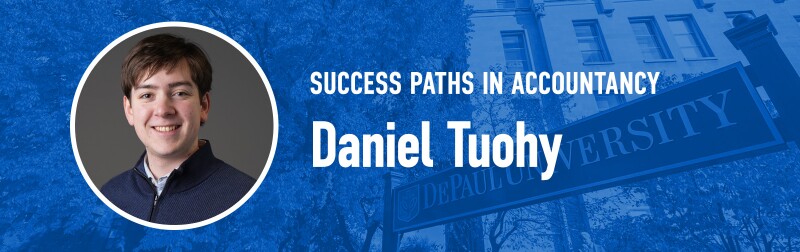
When Daniel Tuohy started his undergraduate degree at DePaul, he wasn’t sure what he wanted to do with his career. He was a musician, a radio program manager and a self-described shy student who sometimes let opportunities pass him by. Accounting wasn’t even on his radar at first. He noted that he actually struggled with it. Fast forward a few years, and Tuohy is finishing his online Master of Science in Accountancy (MSA) in just 18 months—currently on track to graduate in June of 2026. He’s working as both a graduate assistant and a research assistant at DePaul and is gaining hands-on industry experience as a cost reporting intern at Roth&Co. His story isn’t a straight line, and that’s exactly what makes it worth reading.
If you’re a prospective student wondering whether you have the right background for graduate-level accounting, whether you can balance work and school or whether online learning can actually work for you, Tuohy’s experience speaks directly to all three.
You Don’t Need a Traditional Accounting Background
Tuohy’s undergraduate path at DePaul included majors in Finance and Communications and Media—not exactly a traditional on-ramp to a Master’s in Accountancy. He managed his high school’s radio program, played music and came to finance with more curiosity than certainty. Accounting, he admits, was something he initially struggled with.
Somewhere along the way, however, things clicked. “By the time I was graduating, accounting was the side of finance that I was most interested in,” Tuohy said. Watching his mother, a CPA who genuinely loves her work, didn’t hurt either.
What Tuohy also came to realize is that his background in radio and music had given him something valuable: a toolkit of transferable skills. Patience, discipline, confidence, the ability to communicate clearly and work well in a team weren’t just soft extras. They were exactly the kinds of skills that would serve him in a demanding graduate program and a professional accounting environment.
For prospective students who worry that their background isn’t accounting-specific enough, Tuohy’s path is a reminder that the skills that make a great accountant aren’t always built in a classroom. Sometimes they’re built in unexpected places.
Balancing Work, School and Everything Else
Almost every prospective MSA student asks whether or not they’ll be able to handle the workload, and Tuohy’s answer is both honest and encouraging: it’s possible, but it requires intention.
During the fall quarter alone, Tuohy was taking three MSA courses simultaneously and working as a graduate assistant—helping faculty with research, proctoring exams and supporting department events. In Winter 2026, he maintained the same courseload and his graduate assistantship and added a part-time internship at Roth&Co. That’s a demanding combination by any measure.
So how does he manage it? “To take three classes at once, with two part-time jobs, I had to learn to love being busy,” Tuohy said. But he’s quick to point out that the MSA program’s structure makes that kind of schedule achievable. Consistent Sunday due dates give him the full weekend to study and submit work. Weekly office hours keep him connected to the faculty. And when conflicts arise, professors make it easy to keep pace.
His advice to prospective students who are worried about balance is practical and hard-won:
- Communicate with your professors. Faculty are responsive and accommodating, but they can only help if they know what you’re dealing with
- Start slow if you need to. Tuohy took one course at a time for his first three quarters before ramping up. That gradual adjustment made a real difference
- Take advantage of summer and winter course offerings. Spreading out your coursework strategically can relieve pressure when your schedule gets heavy
“Earning a graduate degree while working isn't easy, especially if you want to maintain a high GPA and finish in a timely manner,” Tuohy said. “What has made this program work for me is the consistently high standards of the MSA program, its faculty and its learning systems.”
When Coursework Meets Real-World Experience
One of the most distinctive parts of Tuohy’s MSA experience is how fluidly his academic work and professional experience have informed each other, often in real time.
As a research assistant, one of his first assignments was compiling every Public Company Accounting Oversight Board case into a database before he had taken a single audit course. Rather than being intimidated, Tuohy used the task as a prompt to dig deeper on his own. “Compiling the data passively educated me on the subject,” he explained. When he eventually took his first audit class, he already had a meaningful frame of reference.
His internship at Roth&Co has offered a similar kind of back-and-forth. While taking audit and tax courses in the MSA program, Tuohy found himself having genuine conversations with audit and tax professionals at the firm. In one moment he recalled, he asked an auditor on staff to describe what they had done that day. The auditor’s answer touched on client sampling wait times, a detail Tuohy recognized from his coursework but hadn’t fully appreciated as a real-world friction point until that conversation.
“The MSA coursework provided me a fluency in accounting terminology,” Tuohy said, “which was very beneficial for quickly adapting to a somewhat niche accounting function like Medicaid Cost Reporting.”
That fluency didn’t come from memorization alone. It came from the combination of rigorous coursework, research experience and a willingness to ask questions—in the office, in the classroom, and everywhere in between.
Letting the Path Take Shape Over Time
Tuohy will be the first to tell you that he doesn’t have everything mapped out. He’s genuinely interested in cost reporting and could see himself building a career there. He’s also intrigued by auditing. The MSA program, he said, has exposed him to enough different corners of the accounting world. His immediate plans are to continue studying for the CPA exam, with the goal of starting the exam process by the end of 2026. Tuohy noted that an interesting feature of the MSA program is that many classes offer optional CPA exam study materials, which apply the coursework to the CPA exam format.
Tuohy’s openness, combined with the confidence he’s built over 18 months of pushing himself academically and professionally, may be the most important thing he’s taking into the next chapter.
Explore What’s Possible With DePaul’s MSA Program
If you’re considering DePaul University’s online Master of Science in Accountancy (MSA) program and you’re not sure if you’re ready, if you’re too busy or if your background is the right fit, Tuohy’s story suggests that the program meets you where you are. The rest is about showing up.
Interested in learning more? Our rigorous curriculum, taught by expert faculty, will prepare you to take on leadership roles in accounting and help businesses solve complex financial challenges. Review our admissions process today.