
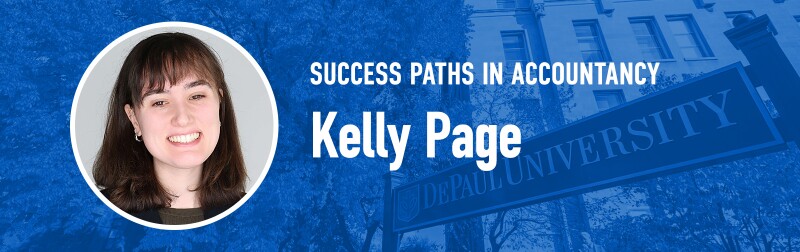
When Kelly Page graduated from Grinnell College with a degree in English, a career in accounting wasn’t on her radar. She spent her early twenties working in education at a Montessori preschool. But in the back of her mind, she knew she wanted to go back to school for a professional degree. She just hadn’t figured out what that would look like yet.
Then she heard about the accountant shortage.
“I was looking for a program because I wanted to go back to school for a professional degree,” Page said. “Even in a bad job market, accounting is hiring. America needs more accountants.”
The more she researched, the more accounting made sense—not just as a stable career, but as a field she could realistically enter. The challenge was finding a program that would work for someone with no prior accounting or business coursework. That’s what led her to DePaul University’s online Master of Science in Accountancy.
A Program Built for Career Changers
Page spent about a year considering the idea before she applied. When she did, DePaul’s MSA was her first and only choice.
“Something great about the program for career changers is that it doesn’t have prerequisites,” Page said. “You can just jump into it.”
Students from diverse academic backgrounds are always welcome. Unlike traditional accounting programs, DePaul’s MSA is designed to take students from zero accounting experience to CPA eligibility. Page will complete the program in approximately 18 months. For someone weighing graduate school options, the efficiency of that timeline stood out.
Accounting Isn’t What You Think
For career changers coming from the humanities, the math element of accounting may seem daunting, but Page cleared that up. “I always say the math is not like calculus. It’s adding and subtracting on a calculator. It’s more conceptual. It’s knowing what to add and subtract.”
This reframe isn’t just Page’s perspective. One of her professors regularly emphasizes that accounting is language-based more than it is math-driven. Students are reading dense technical textbooks, analyzing business law language, and writing through complex scenarios—skills that felt surprisingly familiar to someone with an English degree.
“There are a lot of times where you’re having to read language and really think about it and analyze it and understand what’s going on,” Page said of her auditing and business law coursework. “Those language skills are always going to be useful.”
Rather than feeling like a disadvantage, Page’s liberal arts background has proven to be a genuine asset. She credits her undergraduate education with teaching her how to think critically and how to learn—skills she’s applied directly to mastering accounting concepts.
“I’d say you might be surprised what it entails to study accounting, especially if you’ve never taken accounting or any sort of business classes before,” Page said. “It is a lot more aligned with people who studied the humanities than you would think.”
Discipline Makes the Difference
Page doesn’t sugarcoat the workload. She uses the Pomodoro method to stay focused: 25 minutes of work, a five-minute break, repeat. She keeps a meticulous calendar. And she’s maintained a 4.0 GPA throughout the program.
“It takes discipline,” Page said, echoing advice from one of her professors. “Accounting takes discipline. You have to practice it. You can’t just read it once and understand it. You have to really dig through it.”
But she’s also quick to point out that the results are there for anyone willing to put in the effort. “If you want a 4.0 in this program, all you have to do is apply yourself. It’s not impossible."
The program’s asynchronous online format supports that discipline with built-in structure. Most professors post weekly assignments and quizzes that keep students on pace. And for Page, the asynchronous lectures have become one of her favorite aspects of the program.
“I really like having online asynchronous lectures, not just because of the flexibility, but because you can pause, rewind, go back to it later before a test,” she said.
The flexibility extends to scheduling. Page has been able to balance her coursework with her work as a substitute teacher for Chicago Public Schools and her graduate assistantship, building her week around the commitments that matter most in any given quarter.
“My schedule can be whatever I want it to be,” she said. “I would say you get a full DePaul experience.”
Going Beyond the Coursework
Two quarters into the program, Page applied for and received a graduate assistantship—an opportunity that has deepened both her knowledge and her connection to DePaul’s campus community.
Despite being enrolled in a fully online program, Page goes in person each week to run labs for DePaul’s introductory financial accounting course. She leads students through practice worksheets, delivers mini-lectures, holds tutoring sessions, and grades assignments. The experience has reinforced her own command of the material in ways she didn’t anticipate.
“Grading makes me really understand it too because I’m looking for all the different mistakes that can happen,” she said. “It just makes me a lot more confident in my knowledge.”
The assistantship has also given her something that can be harder to come by in an online program: face-to-face relationships with faculty and fellow graduate assistants.
“I get to form deeper connections with the faculty at DePaul, which, being in an online program, there’s always a little bit of distance,” Page said. “Just seeing people around in the department and stuff is really cool.”
She describes the experience as “very empowering”—and practical preparation for the CPA exam, where the foundational concepts she’s been teaching will need to be second nature. Page also noted that helping students learn the material that she enjoyed learning herself has been a rewarding experience.
From the Classroom to a Career
One of Page’s biggest takeaways from the program has been the career support DePaul provides. The Kellstadt Graduate School of Business hosts Meet the Firms, a career fair held multiple times a year where dozens of accounting firms send recruiters to meet students face-to-face.
“There are around 50 firms there that are represented. They send recruiters, and you get to go around and shake hands with them and talk to them and give them your resume,” Page said. “Getting that face-to-face time is really valuable.”
It was through Meet the Firms that Page identified the firm she wanted to work for. She also took advantage of DePaul’s career mentorship program, working with a career coach to refine her resume and polish her elevator pitch.
The result: before graduating, Page secured a position as an audit associate at a major accounting firm, set to start in the fall.
“DePaul gave me a lot of support in finding a job at the end of the day,” she said.
Advice for Prospective Career Changers
Looking back, Page admitted she was nervous before starting the program. She wasn’t sure she’d be able to keep up, let alone excel. But the anxiety gave way quickly once she committed to the work.
Her advice for anyone considering a similar leap: don’t let assumptions about accounting—or about your own background—hold you back.
“There’s a lot of transferable skills into accounting from someone with an education background, someone with a journalism background,” she said. “Don’t be intimidated by working with numbers.”
And if you’re someone who studied the humanities and is wondering whether accounting could be the right fit, Page’s answer is direct.
“My English degree taught me how to learn. I think that’s a big part of a liberal arts education—learning how to think and learning how to learn. And you can apply that to anything, but definitely to accounting.”
Find Your Own Path to Accounting With DePaul Online
Are you ready to begin or elevate your own accounting career? The online Master of Science in Accountancy (MSA) program at DePaul University can help you develop the skills and knowledge needed to succeed. Our rigorous curriculum, taught by expert faculty, will prepare you to take on leadership roles in accounting and help businesses solve complex financial challenges. To learn more, review our admissions process today.