
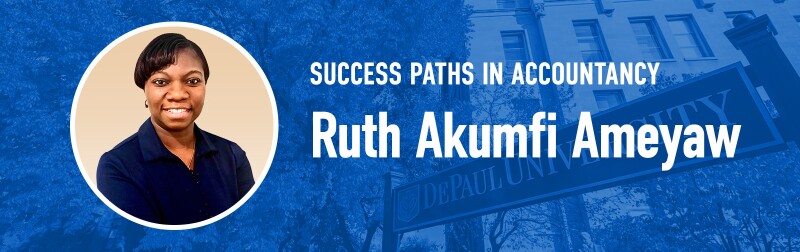
Ruth Akumfi Ameyaw doesn’t leave her career to chance. When she immigrated to the United States from Ghana in 2016, she arrived with a bachelor’s degree in accounting and an Association of Chartered Certified Accountants (ACCA) certification—a prestigious international credential focused on global reporting standards. However, the ACCA credential does not translate to the U.S. accounting profession.
“When I came to America, it’s not recognized here. You need the CPA,” Ruth explained.
For many professionals, this would have been a setback. For Ruth, it became an opportunity to reposition herself for long-term success—including her ultimate goal of reaching C-suite leadership roles.
“While my undergraduate degree provided a solid foundation in accounting principles, I realized early in my career that the profession demands deeper technical expertise, stronger analytical judgment, and a broader understanding of complex reporting and regulatory environments,” Ruth reflected. “I was also intentional about meeting the educational requirements for the CPA while positioning myself for long-term career growth. Pursuing a Master’s in Accountancy was a strategic decision to sharpen my technical skills, strengthen my professional credibility, and accelerate my career trajectory.”
Choosing DePaul: Location, Reputation, and Career Access
When Ruth decided it was time to pursue her master’s degree—balancing three young children (ages two, seven, and 10 at the time) and full-time work—she was selective about her program choice.
“DePaul stood out to me because of its strong reputation in accounting education, its close ties to the professional services industry, and its emphasis on practical, real-world application,” she said. “I was particularly drawn to DePaul’s location in Chicago, which offers unparalleled access to major accounting firms and corporate employers.”
That access to Chicago’s robust accounting industry wasn’t just theoretical. The program’s flexibility made it possible for Ruth to gain professional experience while completing her degree. Additionally, the connections she made would prove instrumental in advancing her career.
Beyond Flexibility: What Graduate-Level Rigor Really Means
Ruth is candid about the demands of DePaul’s Master of Science in Accountancy program. While the online format provided the flexibility she needed as a working mother, the academic rigor was significant.
“The master’s program was significantly more rigorous, fast-paced, and application-driven than my undergraduate coursework,” she noted. “While undergraduate classes focused primarily on learning accounting standards and rules, the graduate program required rapid application of those standards to complex, real-world scenarios.”
The 10-week quarter system moved quickly, with courses demanding case studies, research assignments, and ambiguous fact patterns that mirrored professional practice. “The expectation was not just to arrive at the correct answer, but to defend conclusions using authoritative guidance, sound judgment, and clear professional reasoning—often under tight deadlines similar to those in the workplace.”
When asked how she managed the demanding workload while working full-time and parenting three young children, Ruth’s answer is straightforward: “I don’t have a choice; it’s a motivation, you know. Motivation and determination to do it.”
She relied heavily on structured schedules, prioritization, and proactive communication. But the effort paid immediate dividends. “While demanding, the experience was extremely rewarding because I could immediately apply what I learned in class to my work. The integration of academics and professional experience reinforced my learning and better prepared me for full-time roles.”
Advanced financial reporting and research-driven coursework presented the greatest challenges. “I addressed these challenges by enhancing my technical research methodology, effectively utilizing authoritative guidance, and incorporating feedback from both peers and faculty,” Akumfi Ameyaw explained. “This experience strengthened my professional judgment, technical rigor, and ability to clearly communicate well-supported accounting conclusions.”
The Mentorship That Made the Difference
While the curriculum was rigorous and practical, Ruth emphasizes that faculty mentorship was instrumental in translating her education into career opportunities—a crucial component of her strategic career investment.
Two professors, in particular, had a lasting impact: Professor Ning Du and Professor Margaret Tower.
“Professor Du helped strengthen my technical foundation and analytical thinking through rigorous, application-focused instruction,” Ruth recalled. But her support extended far beyond the classroom. “Professor Du played a key role in helping me secure my internship at Plante Moran and provided invaluable guidance throughout my job search.”
Professor Margaret Tower’s mentorship was equally transformative. “Professor Tower’s support went far beyond what I expected—she offered consistent coaching, exposed me to her professional network, and provided personal encouragement throughout the process. I am deeply grateful for their mentorship and the lasting impact they have had on my academic and professional journey.”
Ruth met with both professors through a combination of in-person meetings and online office hours, demonstrating that even in an online program, meaningful mentorship relationships are possible—and essential.
“Both professors brought valuable industry perspectives into the classroom and emphasized ethics, critical thinking, and professional judgment—lessons that continue to shape how I approach my work today,” she added.
From Classroom to CPA: Aligned Preparation for Professional Certification
Ruth’s strategic approach to her master’s degree included a clear focus on CPA preparation—a critical credential for her long-term career goals.
“The coursework aligned closely with CPA exam content, particularly in areas such as financial reporting, auditing, taxation, and research,” she noted. “Courses reinforced discipline, time management, and technical depth, all of which are essential for CPA preparation. Beyond content knowledge, the program helped me develop the mindset and study habits required to succeed in professional certification exams.”
That preparation is already paying off. Ruth has successfully passed the FAR (Financial Accounting and Reporting) section of the CPA exam and is working toward completing the remaining three sections.
The ROI That Extends Beyond Salary
Now working as a staff accountant at The Reynolds and Reynolds Company, Ruth has a clear perspective on whether her master’s degree was worth the investment—particularly given the sacrifices it required as a working mother.
“Yes, without question,” she said emphatically. “The Master’s in Accountancy has provided me with strong technical skills, expanded career opportunities, and long-term professional confidence. The return on investment goes beyond salary—it includes credibility, career mobility, and a solid foundation for future leadership roles.”
That last point is crucial. Ruth isn’t just thinking about her next role—she’s building toward C-suite positions, with CFO roles in her sights. The combination of her master’s degree, CPA certification, and strategic career moves positions her to achieve those ambitious goals.
“The master’s degree significantly strengthened my job prospects by making me more competitive for professional roles and demonstrating my commitment to the field,” she explained. “Employers valued both the technical depth and the maturity that came with graduate-level training. It also helped position me for roles with greater responsibility and long-term growth potential.”
Lessons Learned: Communication Matters as Much as Technical Skills
In her current role, Ruth’s typical day involves preparing and reviewing journal entries, reconciling accounts, supporting month-end close activities, and ensuring compliance with accounting standards. She also collaborates with cross-functional teams, analyzes variances, and supports internal and management reporting—including assisting with external audit requests.
Through this work, she’s learned something she wishes she’d known earlier in her career: technical accounting skills are only part of the equation.
“I wish I had known how critical communication and professional judgment are alongside technical accounting skills,” Ruth reflected. “Accounting is not just about producing accurate numbers—it’s about clearly explaining those numbers, exercising sound judgment, and understanding their impact on business decisions. Developing these skills early makes a significant difference in effectiveness and career growth.”
Fortunately, DePaul’s program helped her develop those skills. “I did improve during the program because we, especially when we’re doing financial reporting, it was more like more communication because the professor wants us to talk,” she recalled. The program required presentations, defending conclusions, and articulating complex accounting positions—all skills that translated directly to her professional work.
Advice for Prospective Students: Be Intentional and Network Early
For professionals considering DePaul’s Master of Accountancy program, Ruth offers advice based on her experience.
“Be intentional about your goals and take full advantage of the resources available,” she emphasized. “Engage with professors, network early, and seek practical experience alongside your studies. The program is rigorous, but it is extremely rewarding if you commit fully.”
If she could do anything differently, Ruth says she would have started networking even earlier. “While the program prepares you well, early exposure helps clarify long-term goals,” she noted. Her advice is particularly relevant for online students who might assume networking opportunities are limited—Ruth’s experience demonstrates that connections are available, but students need to be proactive in seeking them out.
She also encouraged prospective students to think beyond their immediate career moves. “I would start networking even earlier and be more proactive in exploring different career paths within accounting,” she reflected.
A Foundation for Future Leadership
As Ruth continues working toward completing her CPA certification while advancing in her accounting career, she does so with confidence that her master’s degree was a strategic investment that will continue paying dividends throughout her career.
“What I enjoy most is solving problems and seeing how accurate financial information supports business decisions,” she said about her current work. And while she acknowledged that managing deadlines during close periods while maintaining accuracy can be challenging, she noted that “these challenges have helped me grow professionally and build resilience.”
That resilience—built through navigating international credential requirements, balancing family and career, completing a rigorous graduate program, and pursuing CPA certification—positions Ruth well for the leadership roles she’s working toward.
For Ruth Akumfi Ameyaw, the path to the C-suite is paved with deliberate choices, strategic investments in education and credentials, and the kind of determination that comes from knowing exactly where you want to go—and being willing to do what it takes to get there.
Start Your Own Journey to Accounting Mastery
Ruth Akumfi Ameyaw graduated from DePaul University’s online Master of Science Accountancy program in 2025. Are you interested in advancing your own accounting career with thorough training and notable credentials?
DePaul University’s online Master of Science in Accountancy program provides the coursework needed to prepare you for the CPA exam and beyond. Graduate with the knowledge and skills you need to excel as a CPA and move from junior to senior positions with higher earning potential.
If you are ready to take the next step, review our admissions requirements today.