
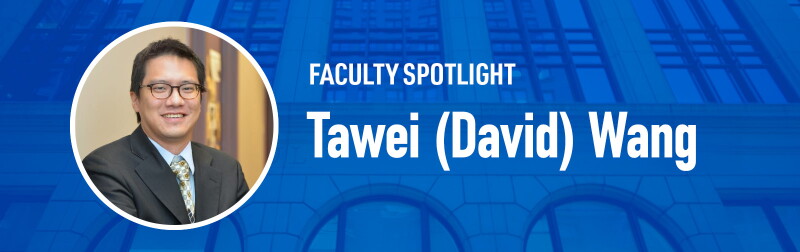
When many people think about accounting, they picture financial reporting, tax preparation, and compliance work. Tawei (David) Wang, the KPMG/Neil F. Casson Endowed Professor and Director of the MS Audit and Advisory Services Program at DePaul University, has spent his career dismantling that image and replacing it with something far more interesting.
Wang’s own path is a good place to start. He earned his BBA and MBA in Accounting in Taiwan, building a strong foundation in the fundamentals of the profession. Along the way, he became interested in the bigger questions underneath: How do organizations actually use technology? Where are the risks? How do you design systems that support better decisions? Those questions eventually led him to Purdue, where he earned a PhD in Management Information Systems.
It might look like a departure from accounting. Wang sees it differently.
“It’s not really moving away from accounting,” he said. “It’s more about understanding the technological environment and all these business issues from a totally different perspective. It’s not just from the accounting or transaction processing perspective, but it’s more about how we can support business decisions.”
That crossover—between the discipline of accounting and the complexity of information systems—is the foundation of how Wang teaches and researches today. And it turns out, it’s also a pretty accurate preview of where the accounting profession is heading.
Accounting Has Quietly Transformed
Here’s what Wang wants prospective students to understand: the accounting profession has already changed. The version of the job that most people imagine—heads-down, process-driven, rule-following—is giving way to something broader, more strategic and considerably more interesting.
“The accounting profession is now more strategic and technology-enabled,” Wang explained. “It’s not the traditional transaction processing, following the rules.”
The scope of who accountants serve has expanded, too. It’s no longer just about reporting users or shareholders. Wang points to a wider web of legal, regulatory and ethical responsibilities that today’s accounting professionals are expected to navigate. And as technology has taken over more of the execution, the human role has shifted accordingly.
“In the past, it was more about accountants being able to follow a process and execute it. Now, what students are facing is being able to design the process, evaluate it and improve it. So, you can see the role is actually shifting to something a little bit broader,” he said.
That shift, he noted, is a genuinely good development for the profession, and for the students entering it. When you start thinking like a designer rather than an executor, you’re suddenly asking richer questions. What are the risks? What decisions does this process need to support? What could go wrong, and how do we build for that? These are the kinds of questions that require critical thinking, not just technical competency.
A Classroom at the Edge of What’s Known
Wang’s research sits squarely at this intersection of accounting and technology. His work on information security management and IT management has been published in top journals across both fields, and he doesn’t keep that work locked away in academic papers. It shows up in his classroom, sometimes in real time.
He describes discussions about AI-related issues in class where one of his students, a state representative, helped translate that conversation into actual legislation. Topics like cybersecurity, AI governance and data privacy aren’t case studies from five years ago in Wang’s courses. They’re live, unresolved problems.
“It’s not just about theoretical issues,” Wang said. “These are exactly what organizations are facing day-to-day, but we don’t have an exact answer or the best solution to give them at this moment. The students, this is something they will get into.”
His experience as a Fulbright Specialist—selected to help universities around the world build analytics curricula for accounting and auditing programs—adds another layer to how he thinks about preparing students. Working across different countries and institutional contexts reinforced a lesson he now brings back to Chicago: technology doesn’t exist in a vacuum, and neither does accounting.
“It’s not really a one-size-fits-all,” Wang says. “It’s not just about how we teach students; it’s also about how they can apply the knowledge. They will be more aware that there are different issues, different perspectives they need to be aware of when they’re actually in practice.”
For students who will go on to work with global companies—many of them headquartered in Chicago—that kind of contextual awareness isn’t a soft skill. It’s a professional edge.
For his work in the classroom, Wang was recently awarded the EYARC Catherine Banks Disruptor Award from the Leadership Section of the American Accounting Association. The award recognizes innovative approaches to preparing accounting students for a rapidly evolving global profession.
What a Chicago Degree Actually Opens Up
DePaul sits at the center of one of the most concentrated accounting ecosystems in the country. Big Four offices, major mid-tier firms and a dense network of Fortune 500 companies are all operating within the same city as DePaul, where the students are building their credentials. Wang’s KPMG/Neil F. Casson Endowed Professorship is itself a product of that ecosystem—a collaboration that keeps curriculum current, brings professionals into the classroom as guest speakers and creates direct pathways to recruiting and networking events that students at other programs simply don’t have.
But Wang is thoughtful about what that access actually requires from students.
“DePaul can definitely open the doors to all these opportunities, and we can help you build the connections,” he said, “but the success actually depends on the students who take advantage of them. Do they have the professionalism, the communication skills? Can they meet the commitments or the deadlines?”
In other words, the Chicago network is a resource, but preparation is what turns a resource into an opportunity. Wang sees his job as making sure students arrive at those doors ready to walk through them. Not just with technical knowledge, but with the critical thinking, professionalism and adaptability that the profession is increasingly demanding.
“Our goal is to help students develop all this,” he said. “It’s not just about the content knowledge, but also the professionalism to help them get access to all these possible opportunities.”
Prepare for the Future of Accounting with DePaul Online
The accounting profession is changing faster than most people realize. Wang has spent his career studying exactly how, and building programs that prepare students not just for the profession as it exists today, but for where it’s going next. For students who are ready to engage with that future, DePaul is an excellent place to start.
DePaul University’s online Master’s in Accountancy program, housed within the Driehaus College of Business, prepares you to lead in the modern financial world. Study with expert faculty like Professor Wang, who teaches ACC 535 Principles of Accounting Information Systems.
Take the next step toward a rewarding career by exploring our admissions requirements. To learn more or ask specific questions, contact us.